




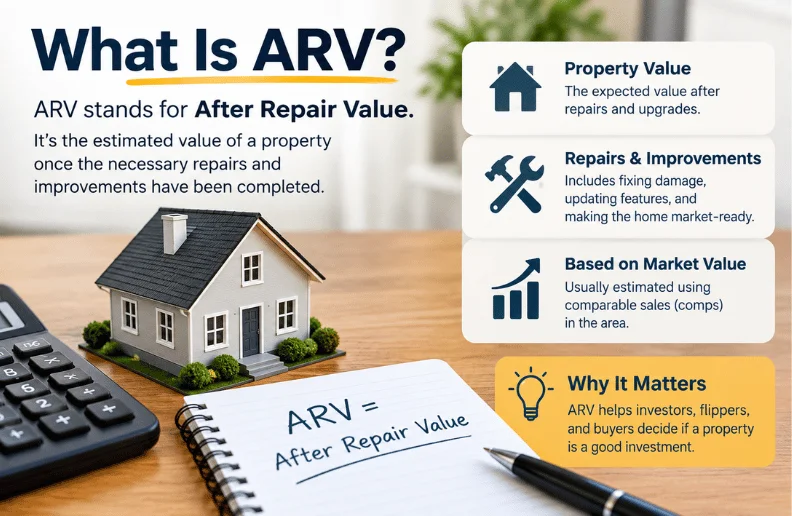
If you’re asking what is ARV , the term means after-repair value in real estate. It estimates a property’s market value after planned renovations are complete. Investors use that estimate to judge purchase prices, renovation budgets, financing, and potential resale margins.
After-repair value estimates what a property could sell for after planned repairs and upgrades are finished. Investors usually estimate it from recent sales of similar renovated homes nearby. The number helps them compare the finished value with purchase, repair, financing, holding, and selling costs before committing money.
| Key point | What it means |
|---|---|
| Full term | After-repair value |
| Main use | Estimate a renovated property’s likely market value. |
| Best evidence | Recent, relevant sales of similar renovated properties |
| Common users | House flippers, wholesalers, rehab investors, and some lenders |
| Related rule | The 70% rule is a rough offer-screening shortcut, not a guarantee. |
| Biggest risk | Weak comps or optimistic assumptions can distort the estimate. |
Key Takeaways
- After-repair value is a forward-looking estimate, not today’s as-is price.
- Strong comparable sales should resemble the finished property in location, size, design, and condition.
- Repair costs do not automatically equal added market value.
- The 70% rule can screen deals, but investors still need full project costs.
- A low, base, and high value range can expose risk better than one optimistic number.
What Is ARV, and Why Does It Matter?
An ARV estimate asks what a property should be worth after the planned work is finished. That makes it different from the home’s current distressed or outdated value. The estimate should reflect the condition buyers will see when the project is complete.
For investors, the number becomes a reference point for several major decisions. It helps test whether the purchase price leaves enough room for repairs and selling costs. It can also support financing discussions when a lender considers the property’s expected completed value.
How to Calculate After-Repair Value From Comparable Sales
Start with closed sales of renovated properties that compete with the subject property. Favor homes in the same market area with similar physical and legal characteristics. Fannie Mae’s appraisal guidance also emphasizes condition, finished area, style, site, and market relevance.
Next, compare meaningful differences between each sale and the finished subject property. Bedrooms, bathrooms, garages, lot size, condition, and location can change buyer behavior. Adjustments should reflect market evidence rather than arbitrary dollar amounts.
Use several solid sales instead of choosing one unusually high result. Recent sales are useful, but relevance matters more than a rigid distance rule. A nearby sale with a different appeal can be weaker than a slightly farther competitive property.
A Simple Comp Workflow
- Define the renovation scope and expected finished condition.
- Find several closed sales of similar renovated properties.
- Remove sales with major location or property-type differences.
- Adjust remaining sales for meaningful value differences.
- Reconcile the adjusted results into a reasonable value range.
- Recheck market conditions before making a final offer.
A professional inspection can also improve the repair scope before you price a deal. BusInvesty’s home inspection guide explains how inspections can uncover defects before purchase. Better repair information reduces the chance that hidden work destroys the projected margin.
Use a Range Instead of One Perfect Number
Suppose three adjusted renovated comps indicate values of $285,000, $295,000, and $305,000. A base estimate near $295,000 may look reasonable for initial analysis. You should still keep the $285,000 to $305,000 range visible.
That range helps you test what happens if the market softens or the finish quality disappoints buyers. It also keeps the analysis from depending on one favorable comp. Conservative underwriting becomes especially important when the expected profit margin is narrow.
This range method does not replace an appraisal or professional valuation. It gives investors a practical sensitivity test before committing capital. The goal is to understand downside exposure before a purchase contract removes flexibility.
How the 70% Rule Uses After-Repair Value
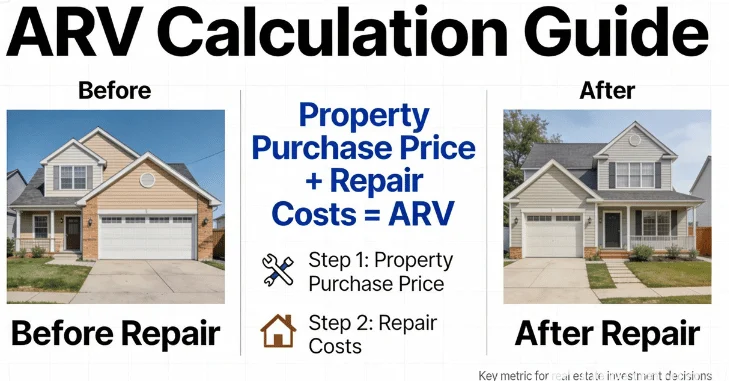
A common investor shortcut starts with 70% of the expected finished value, then subtracts estimated repair costs. The resulting figure is often called a maximum allowable offer, or MAO. It is a screening tool rather than a universal pricing law.
MAO = (ARV × 70%) − estimated repair costs
Using the $295,000 base estimate, 70% equals $206,500. Subtracting $45,000 in repairs produces a $161,500 screening price. The result does not automatically make that purchase price safe.
Real deals also include financing, taxes, insurance, utilities, closing costs, commissions, and unexpected repairs. Market speed and required profit can change the acceptable purchase price too. Investors may use different percentages depending on market conditions and their required margins.
ARV vs. As-Is Value, Market Value, and Appraised Value
| Term | What it describes | When it matters |
|---|---|---|
| ARV | Estimated value after planned renovations | Deal analysis and some rehab financing |
| As-is value | Value in the property’s current condition | Purchase negotiation and current collateral analysis |
| Market value | Likely price under current market conditions | Buying, selling, and valuation |
| Appraised value | An appraiser’s supported opinion for a specific assignment | Lending, transactions, estates, and other formal uses |
These figures can overlap, but they answer different questions. A renovated property’s market value may approach the projected finished estimate once work is complete. Before completion, the forward-looking estimate remains uncertain.
An investor’s calculation is also not the same as a lender’s appraisal. A lender may require its own valuation method, documentation, and eligibility rules. Treat your estimate as a decision tool rather than an official guarantee.
Common ARV Mistakes That Can Ruin a Deal
The most dangerous mistake is selecting comps because they support the price you want. Another mistake is comparing a premium renovation with a basic planned finish. Both choices can inflate the finished value before work even begins.
Investors can also underestimate differences between nearby micro-markets. School boundaries, traffic, flood exposure, lot position, and property type can affect demand. A comp should attract the same kind of buyer, not merely share a ZIP code.
Recurring Problems to Avoid
- Using active listings as if they were confirmed sale prices.
- Comparing renovated homes with properties needing substantial work.
- Ignoring major layout, lot, garage, or location differences.
- Assuming repair spending creates equal dollar-for-dollar value.
- Relying on an automated estimate without checking renovated comps.
- Forgetting that market conditions can change during the rehab period.
How Lenders May Use the Finished Value
Some private, bridge, and rehabilitation lenders consider expected completed value when underwriting a project. They may compare that value with purchase costs, repair budgets, borrower strength, and loan terms. Each lender applies its own limits and documentation requirements. Federal rules can apply as well. The Consumer Financial Protection Bureau’s appraisal rule for higher-priced mortgage loans requires a second appraisal when a seller resells within 90 days at more than 10 percent above the price they paid. A resale 91 to 180 days after purchase triggers the same requirement above 20 percent.
That means your investment estimate may not match the lender’s final valuation. A lower lender value can reduce proceeds or require more cash. Review BusInvesty’s Service Business Examples guide when comparing financing structures for investment properties.
Before choosing financing, build a complete project budget rather than focusing only on value. Include interest, points, draw fees, holding time, insurance, taxes, and selling expenses. A profitable-looking spread can shrink quickly when carrying costs rise.
When Should You Get Professional Help?
Consider professional help when the property is unusual; the local market has few strong comps. A local agent or appraiser may identify competitive sales you missed. Contractors and inspectors can also improve repair estimates before you commit.
Professional input is especially useful for rural properties, mixed-use assets, luxury homes, and major structural rehabs. These properties often need broader judgment than a quick comp average provides. Fannie Mae guidance permits broader market searches when better comparable evidence requires them.
You can explore BusInvesty’s Small Business section for more property-investing and due-diligence topics. Use those resources as a starting point, then verify deal-specific numbers locally. Real estate value depends on the property, market, timing, and planned finish.
Frequently Asked Questions
What is ARV in real estate investing?
ARV means the estimated after-repair value of a property once planned renovations are complete. Investors usually estimate it from comparable renovated sales. They use the result to evaluate potential purchase prices, financing needs, and resale margins.
Is the 70% rule always accurate?
No, the 70% rule is a rough investor screening method. Local margins, financing costs, taxes, selling expenses, and competition can justify different percentages. A full project budget should support the final offer.
How many comps should I use?
Use several strong closed sales rather than relying on a single transaction. Three relevant sales can provide a useful starting point, but extra evidence may improve confidence. Quality and comparability matter more than collecting many weak examples.
Can an online home-value estimate replace comps?
An automated estimate can provide context, but it may not reflect your exact renovation plan. It can also miss condition and neighborhood details that affect buyers. Use actual renovated sales and local evidence for investment underwriting.
Is ARV the same as an appraisal?
No, an investor’s estimate is not automatically a licensed appraisal. Appraisers follow assignment standards, market evidence, and lender requirements when producing formal opinions. Your estimate can guide decisions, but it does not guarantee a future sale price.
Final Takeaway
After-repair value is most useful when you treat it as evidence-based underwriting, not a hopeful resale target. Start with competitive renovated sales, make defensible adjustments, and keep a realistic value range. Then test the deal against every major project cost.
If the numbers only work under the highest comp and cheapest repair estimate, the margin may be fragile. Revisit the scope, offer price, and financing before proceeding. For more related guides, browse BusInvesty’s real estate coverage and build your analysis from verified local data.
