




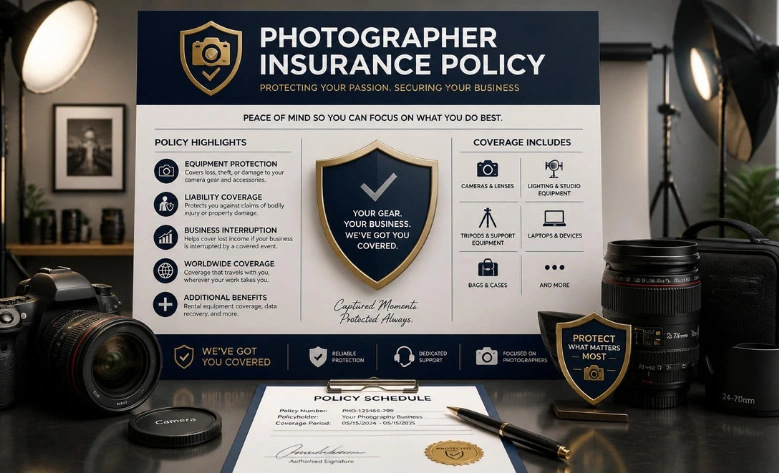
Photographer insurance protects a photography business from risks that can turn one shoot into a major financial loss. A client could trip over a light stand, expensive gear could disappear between locations, or a customer could claim that promised work was never delivered. The right policy mix depends on where you work, the value of your equipment, whether you employ anyone, and the services you promise clients.
| Key question | Practical answer |
| Core coverage to consider | General liability, professional liability, and equipment coverage |
| Useful for mobile gear | Inland marine or tools and equipment coverage |
| Important for studios | Commercial property or a business owner’s policy |
| Employees | Check your state’s workers’ compensation requirements. |
| Vehicles | Review commercial auto or other business-use vehicle coverage. |
| Client files | Consider cyber coverage when you store sensitive data or galleries. |
| Drone work | Confirm FAA compliance and whether separate UAS coverage is needed. |
| Typical GL cost benchmark | Published provider data ranges from roughly $17 to $29 per month for many small photography businesses |
| Venue work | A venue may ask for a certificate of insurance and additional insured status. |
Direct answer: Most U.S. photography businesses should start by considering general liability, professional liability, and equipment coverage. Add workers’ compensation when state rules require it for employees, commercial auto when vehicle use creates a business exposure, cyber coverage for client data risks, and drone coverage when aerial work creates aviation exposures.
Key Takeaways
- General liability addresses common third-party injury and property-damage claims.
- Professional liability can address allegations involving inadequate professional services or failure to deliver.
- Equipment coverage deserves special attention when cameras, lenses, lighting, and computers regularly leave a studio.
- A standard homeowners policy may leave gaps for a home-based photography operation.
- Venue contracts may require proof of liability coverage before an event.
- Cost depends on location, revenue, payroll, claims history, limits, equipment value, and chosen policies.
- Policy wording matters more than the product name, so compare exclusions and limits before buying.
What Photographer Insurance Usually Covers
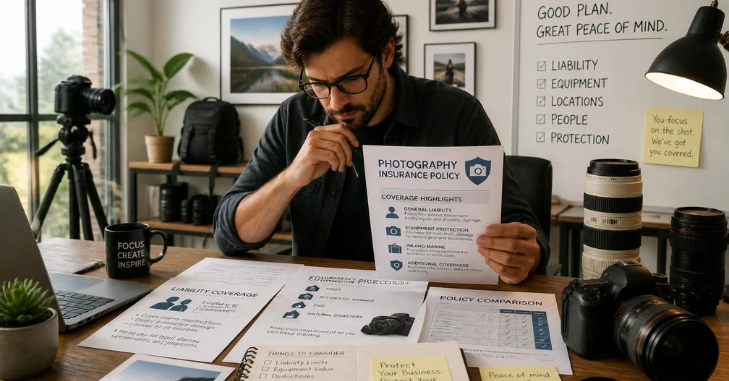
Photography businesses face several different types of risk, so there is no single policy that solves every problem. The National Association of Photographer Insurance Commissioners separates business liability, professional liability, property, cyber, workers’ compensation, and vehicle-related risks into different coverage areas. Your goal is to match each meaningful exposure in your business with a policy that responds to it.
| Coverage | What it may address | Example photography risk |
| General liability | Third-party bodily injury and property damage | A guest trips over a tripod. |
| Professional liability or E&O | Claims involving professional services | A client alleges you failed to deliver contracted work. |
| Equipment or inland marine | Covered loss to mobile business equipment | Cameras or lighting are stolen or damaged away from the studio. |
| Commercial property | Property at a covered business location | A covered fire damages studio equipment. |
| Business owner’s policy | Often combines liability and property coverages | A studio wants several core protections in one package. |
| Workers’ compensation | Work-related employee injury or illness | An employee is hurt while setting up a shoot. |
| Commercial auto | Covered business vehicle exposures | A vehicle used for work is involved in a crash. |
| Cyber liability | Certain data breach and cyber incident costs | Client information or online galleries are compromised |
| Drone or UAS coverage | Aviation-related liability or physical damage, depending on policy | A commercial drone damages third-party property. |
Mobile equipment deserves its own review because standard property coverage may focus on a listed location. The Insurance Information Institute explains that inland marine insurance can cover equipment while it is transported or temporarily away from the main premises, and it specifically identifies photography equipment as a potential use. Ask whether your cameras, lenses, computers, lighting, memory devices, rented gear, and accessories are covered wherever you use them.
Professional liability is different from general liability because it focuses on the service you provide rather than a physical accident. A customer dispute could involve missed deliverables, lost files, alleged mistakes, or a claim that your services did not meet contractual expectations. Read the definition of covered professional services carefully because exclusions, deductibles, defense costs, and limits vary by insurer.
How Much Does Photography Business Insurance Cost in 2026?
There is no national flat rate because insurers price businesses according to their individual exposures. Published pricing pages available in 2026 show that small photography operations can sometimes obtain basic liability coverage for a modest monthly premium, while businesses with more gear, employees, vehicles, or specialized work pay more. Treat online averages as budgeting benchmarks rather than a substitute for a quote.
| Policy | Published monthly benchmarks | Sources |
| General liability | About $17–$29 | Simply Business and Insureon |
| Equipment/business property | About $21–$43 | Simply Business and Insureon |
| Professional liability | About $34–$36 | Simply Business and Insureon |
| Workers’ compensation | About $56–$62 | Simply Business and Insureon |
| Business owner’s policy | About $45–$46 | Simply Business and Insureon |
Simply Business reports a $17 monthly median for general liability in its cited customer dataset, while Insureon lists a $29 monthly median for freelance photography and videography businesses. NEXT’s September 2026 pricing page also reports many of its photography customers paying around $19 monthly for general liability, which shows how provider populations can produce different averages. Your own premium can differ because insurers consider factors such as location, revenue, employees, claims history, coverage limits, and the value of insured property.
Annual revenue is particularly important because it gives an insurer context about the scale of your operation. If you need to separate gross business income from other financial measures, Businvesty’s explanation of revenue versus sales can help you organize the figures before requesting quotes. Give accurate information on applications because the policy must reflect the business you are operating rather than a smaller or different version of it.
Which Coverage Fits Different Photography Businesses?
Two photographers with the same camera body can have completely different insurance needs. Someone taking occasional portraits at home does not face the same venue, employee, contractual, and equipment exposures as a studio covering weddings every weekend. Start with your actual work pattern instead of buying a package because its name sounds comprehensive.
| Business type | Priority coverages to review | Extra questions |
| Part-time portrait business | General liability, equipment, professional liability | Does home insurance restrict business property or liability? |
| Wedding or event business | General liability, equipment, professional liability | Do venues require a COI or additional insured? |
| Commercial photography | Liability, E&O, equipment, cyber | Do client contracts demand specific limits? |
| Studio operation | BOP/property, liability, E&O | Are fixtures, computers, and business interruption covered? |
| Business with employees | Core coverages plus workers’ compensation | What does state law require? |
| Drone operator | Core policies plus UAS review | Does the policy exclude aircraft or drone activity? |
The table is a starting point, not a universal prescription. A rented studio, a home office, and a short-term workspace can also create different property obligations, so compare the policy with your lease or rental agreement. Businvesty’s guide to coworking space costs and agreements is useful if your business uses flexible workspace rather than a permanent studio.
Insurance Gaps That Can Cost Photographers Money
One common gap involves assuming that commercial property coverage automatically follows equipment everywhere. Photography is unusually mobile, with valuable cameras, lenses, laptops, lighting, and storage devices moving between homes, cars, studios, hotels, and venues. Verify the territory, theft conditions, per-item limits, deductible, replacement terms, and exclusions before assuming your full kit is protected.
Home-based businesses need the same caution because personal insurance and commercial insurance serve different purposes. The Insurance Information Institute notes that homeowners coverage may provide limited protection for business property and may exclude business liability exposures. If you run a creative service business from home, ask your insurer exactly how paid photography changes the protection available under your personal policy.
Client data is another exposure that becomes more important as your business grows. Galleries, addresses, contracts, payment details, release forms, and backup drives can contain information that clients expect you to protect. Businvesty’s guidance on business document management can help with operational controls, while cyber coverage can address certain insured costs after covered digital incidents.
Certificates of Insurance and Additional Insured Requests
Wedding venues, event spaces, commercial properties, and production clients may ask for proof of liability coverage before you start work. A certificate of insurance, commonly called a COI, summarizes details such as policy dates and liability limits, but the certificate itself does not replace the policy contract. Some venues also ask to be listed as an additional insured for liability arising from your operations on their property.
Do not wait until the morning of a shoot to check these requirements. Ask the client or venue for its insurance instructions, required limits, legal entity name, address, and any requested endorsement wording before the event date. Then send those requirements to your insurer or licensed agent so the documents match the contract instead of relying on assumptions.
How to Choose a Photography Insurance Package
Buying coverage becomes easier when you inventory risks before comparing prices. A cheap policy can be poor value if its limits exclude your highest-value camera, if off-site theft is restricted, or if your main service is outside the policy’s definition of covered operations. Use the same business description and requested limits when collecting quotes so you can compare them on equal terms.
- List your equipment at replacement cost. Include cameras, lenses, lighting, computers, storage devices, and other essential gear.
- Map where you work. Note studios, homes, venues, public spaces, travel, and temporary rental locations.
- Review your client contracts. Look for liability limits, COI requests, additional insured requirements, and professional liability clauses.
- Identify people and vehicles. Count employees, subcontractors, second shooters, owned vehicles, and work use of personal vehicles.
- Request comparable quotes. Keep limits, deductibles, and major endorsements consistent when comparing carriers.
- Read exclusions before buying. Pay particular attention to theft, unattended vehicles, water damage, drones, rented gear, subcontractors, and professional services.
- Recheck coverage each year. Update the policy after major equipment purchases, staffing changes, studio moves, or new services.
Price should be one factor in the decision rather than the only factor. Compare the per-occurrence limit, aggregate limit, equipment sublimits, deductible, covered locations, defense provisions, endorsements, and exclusions before choosing. A licensed insurance professional can also explain state-specific rules and policy wording that a comparison table cannot settle.
Employees, Business Vehicles, and Drones Need Extra Attention
Workers’ compensation rules are primarily handled at the state level for private employers, so there is no single employee threshold that applies identically across the country. The U.S. Department of Labor links directly to each state workers’ compensation authority, which is the right place to verify requirements for your location. This matters when a solo operation starts hiring editors, assistants, studio staff, or additional shooters.
Vehicle exposure also deserves a direct conversation with your insurer if you regularly drive for paid assignments or own a vehicle through the business. Do not assume a personal auto contract covers every commercial use, because policy terms and permitted business use vary. Tell the insurer how the vehicle is used and ask what coverage form fits those trips.
Commercial drone photography introduces both insurance questions and federal operating rules. The FAA’s Part 107 rules for small unmanned aircraft systems govern many commercial drone operations under 55 pounds, with additional airspace and operational requirements in certain situations. Ask your carrier whether drone activity is included, endorsed, or excluded because ordinary business liability should not be assumed to cover an aviation exposure.
Protect the Risks That Could Stop Your Business
Insurance works best when it protects the events your business could not comfortably absorb on its own. For a photography company, that may mean a lawsuit after an accident, the loss of a mobile equipment kit, an allegation of failed professional services, or an employee injury. Review those exposures first, then choose limits and deductibles that make financial sense for your business.
Before your next major booking, make an equipment inventory, review your client and venue contracts, and collect comparable quotes from licensed insurers or agents. Ask each provider to explain off-site gear coverage, professional liability, additional insured procedures, and the exclusions that apply to your type of work. Keep the final policy documents and current COI accessible so proof of coverage does not become a last-minute problem.
Conclusion
Photographer insurance is an important part of protecting a photography business from financial risks that can arise during everyday operations. Whether you work from a home studio, travel to weddings and events, operate a commercial studio, or provide specialized services such as drone photography, the right insurance coverage should reflect how your business actually operates.
For many U.S. photographers, general liability, professional liability, and equipment coverage are important starting points. General liability can help address covered third-party injury and property-damage claims, while professional liability may respond to certain allegations involving professional services. Equipment or inland marine coverage can be especially valuable for photographers who regularly transport expensive cameras, lenses, lighting, computers, and other gear between locations.
Frequently Asked Questions
Do I need photographer insurance if I only shoot part-time?
Part-time work can still create business liability when you accept money for a service. A small side business can own expensive gear, work at third-party locations, and face client disputes even with limited annual revenue. Compare the financial impact of a potential claim with the cost of suitable basic coverage before deciding to operate uninsured.
Does business insurance cover stolen camera gear?
It can, but only when the applicable policy covers the property, cause of loss, and location involved. Equipment or inland marine coverage is often worth reviewing for cameras and related gear that travel away from a fixed studio. Check theft exclusions, unattended-vehicle restrictions, per-item caps, deductibles, and requirements for scheduled equipment.
What is the difference between general liability and professional liability?
General liability generally focuses on third-party bodily injury, property damage, and other covered liability claims arising from business operations. Professional liability focuses on claims alleging mistakes or failures in the professional service you agreed to provide. Many photography businesses review both because a physical accident and a service dispute create different exposures.
Do wedding venues require photographers to carry insurance?
Some do, and requirements vary by venue and contract. Event spaces may ask for a COI, specified liability limits, or an endorsement naming the venue as an additional insured before allowing vendors to work on site. Ask for the venue’s written insurance requirements early so you have time to obtain the right documentation.
Can my homeowners policy cover a photography business?
A homeowners policy may offer limited protection for certain business property, but you should not assume it covers a full commercial operation. Business liability, high-value equipment, off-site property, and paid activities can fall outside personal-policy protection or face restrictive limits. Tell your insurer that you operate a paid business from home and ask for a written explanation of what is and is not covered.
What insurance should a freelance photography business buy first?
General liability, professional liability, and equipment protection are sensible policies to evaluate first because they correspond with common physical, service, and gear risks. Your priorities can change if you have employees, maintain a studio, drive a business vehicle, store sensitive client information, or fly drones. The right starting package is the one built around your actual contracts, assets, and working conditions.
