




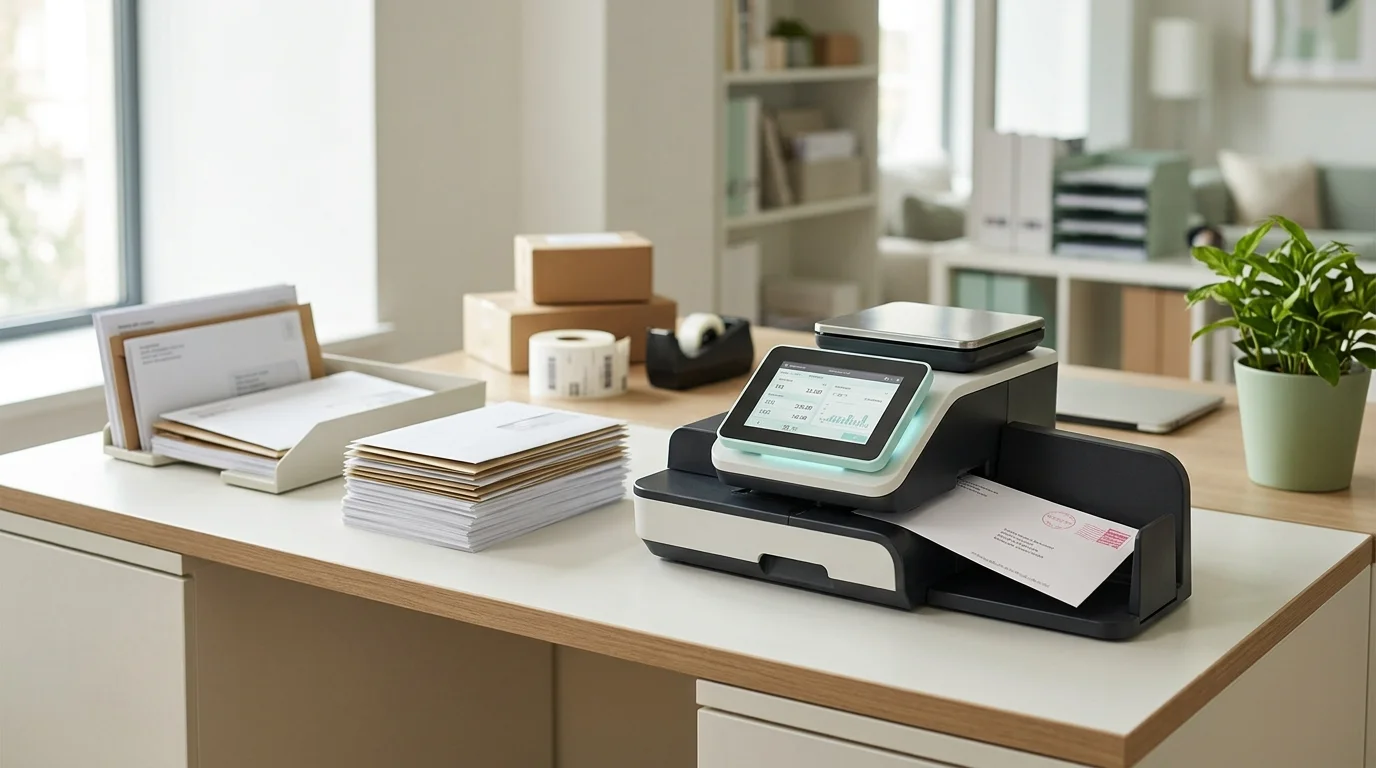
Postage meters let businesses weigh mail, calculate postage, and print USPS-approved postage from the office. They can reduce manual work and help teams track mailing expenses. Businesses that send mail regularly can also cut postage costs.
Quick answer: A postage meter prints prepaid postage directly onto envelopes or approved labels. U.S. businesses must rent or lease the equipment from a USPS-authorized provider. The right system depends on mail volume, processing speed, package needs, reporting features, and total contract cost.
| Key point | What U.S. businesses should know |
|---|---|
| Main purpose | Weigh mail, calculate postage, and print postage |
| Ownership | Meters must be rented or leased |
| Authorized providers | Data-Pac, FP Mailing Solutions, Pitney Bowes, and Quadient |
| 2026 First-Class letter rate | 78¢ metered versus 82¢ stamped |
| Main benefits | Faster preparation, cost tracking, accurate postage, fewer stamp purchases |
| Main costs | Lease or rental, postage, ink, labels, software, and service |
| Current technology | Modern systems use Intelligent Mail Indicia, or IMI |
| Best fit | Businesses that send letters or parcels regularly |
What Are Postage Meters?
Postage meters are mailing systems that print evidence of paid postage on letters or labels. Many models include a scale that calculates the correct postal charge. More advanced systems can feed, seal, label, and account for larger mail batches.
USPS treats these devices as postage evidencing systems. Businesses cannot purchase the actual meter component outright in the United States. USPS says approved equipment must come from an authorized meter provider.
The four authorized U.S. providers are Data-Pac Mailing Systems, FP Mailing Solutions, Pitney Bowes, and Quadient. Vendors determine their own service and leasing charges. That makes contract comparison an important part of choosing a system.
How Does a Postage Meter Work?
Using a meter starts with the weight of your letter or parcel. The machine or connected software then applies the selected USPS service and current rate. It prints the resulting indicium directly on the envelope or an approved label.
Modern connected systems can receive postal rate updates through an internet connection. Many also record spending by user, account, department, or customer. Those records can make expense allocation easier for offices handling mail for several teams.
A typical mailing process follows four steps:
- Place the letter or package on the connected scale.
- Select the appropriate mail class and additional service.
- Print the calculated postage on the envelope or label.
- Place eligible mail into the USPS network for collection or acceptance.
This setup removes the need to keep several stamp denominations on hand. It also reduces guesswork when an envelope weighs more than expected. USPS confirms that metering systems can print indicia directly on mailpieces or approved labels.
Postage Meters and 2026 USPS Rates
One financial advantage comes from the lower metered rate for eligible First-Class Mail letters. Since July 12, 2026, a one-ounce stamped First-Class letter costs 82 cents. The comparable metered price is 78 cents, creating a four-cent difference per letter.
That saving sounds small until mailing volume rises. A business sending 500 qualifying letters monthly saves $20 on the postage rate alone. At 1,000 letters monthly, the difference becomes $40, or $480 across twelve months.
Those numbers do not prove that renting a machine will save money. Equipment, ink, software, service, and contract fees must also be included. Businesses should calculate total operating cost before treating the postage discount as net savings.
How Much Does a Postage Meter Cost?
There is no single nationwide rental or lease price. Providers set their own charges based on equipment, features, processing speed, service, and agreement length. USPS does not set the vendor’s equipment fee.
Current market guides often place basic small-office equipment around $20 to $60 monthly. Mid-volume and automated systems can cost considerably more. Published prices are useful benchmarks, but actual quotes and contract terms control your real cost.
Before signing an agreement, review these expenses.
- Monthly equipment lease or rental
- Postage loaded into the system
- Ink cartridges and printing supplies
- Meter tape or shipping labels
- Software or connectivity charges
- Maintenance and repair coverage
- Installation or setup fees
- Equipment return charges
- Early cancellation penalties
- Automatic renewal provisions
A $25 advertised monthly payment might look cheaper than a $40 alternative. The comparison changes if the first contract adds software, supplies, or service separately. Compare total contract cost instead of the headline monthly figure.
When Does a Meter Make Financial Sense?
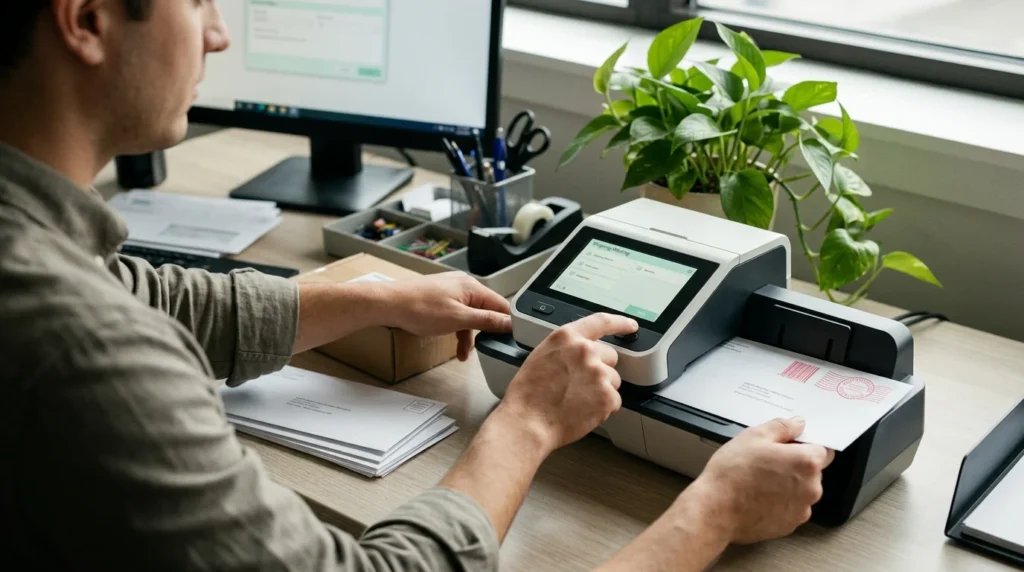
The easiest starting point is your monthly letter volume. Multiply eligible letters by the current four-cent First-Class difference. Then compare those savings with your equipment and supply costs.
Suppose a company sends 800 qualifying one-ounce letters every month. The postal-rate difference produces about $32 in monthly savings. A $40 monthly system would not pay for itself through that discount alone.
That does not automatically make the system a poor choice. Employee time, postage errors, reporting needs, and Post Office trips also carry costs. A business with expensive administrative time may benefit even before direct postage savings cover the lease.
This type of operating-cost review fits the same practical mindset used for other business tools. Businvesty’s coverage of remote-work tools for U.S. teams shows why software and equipment should solve measurable workflow problems. The cheapest option isn’t always the lowest-cost option once staff time is factored in.
Metered Mail Versus Stamps and Online Postage
Stamps remain simple for businesses mailing only a few letters each month. They require no equipment contract and need little training. Their main disadvantages are manual application, limited expense tracking, and the higher eligible First-Class letter rate.
A physical meter becomes more attractive as recurring mail volume grows. It can combine weighing, rating, printing, and tracking in one workflow. Higher-volume machines can also add automatic feeding and sealing.
Online postage offers another alternative for businesses focused on parcels or occasional shipping. USPS describes PC Postage as approved software for buying and printing postage with a computer and printer. Businesses should compare that model with a meter before committing to hardware.
| Option | Strongest use case | Main advantage | Main limitation |
|---|---|---|---|
| Stamps | Occasional letters | No equipment commitment | More manual work |
| Metered mail | Regular office mail | Fast rating, printing, and tracking | Rental or lease costs |
| Online postage | Parcel-heavy or flexible workflows | Print labels using computers | May not suit traditional mailroom workflows |
The right choice depends on how your business operates. A five-person office sending twenty letters monthly has different needs from a medical practice mailing hundreds. Measure the workflow before comparing equipment.
Check IMI Compliance Before Signing a Contract
Intelligent Mail Indicia, or IMI, is the current USPS technology standard for modern metering systems. It provides more detailed information in the postage indicium than older Information-Based Indicia technology. Businesses replacing older equipment should confirm that proposed equipment meets current USPS requirements.
Most older IBI equipment was withdrawn from service by the end of 2024. Certain legacy systems received additional transition time. Those affected systems must be removed from service by December 31, 2027, according to current provider guidance.
Ask the provider to identify the exact model before you sign. Confirm its IMI status, connectivity requirements, and support period in writing. This check can help you avoid committing to equipment that will require a mandatory transition soon.
How to Choose the Right System for Your Business
Start by measuring what leaves your office during a normal month. Count letters, flats, certified items, and parcels separately. Also record unusually busy periods because peak volume may affect the processing speed you need.
Then compare features with your actual operating requirements. A small company may need little more than a scale and basic expense reporting. A busy office may benefit from automatic feeding, sealing, larger scales, departmental accounting, and shipping software.
Use this checklist when comparing providers.
- Average and peak daily mail volume
- Maximum parcel weight
- Letters processed per minute
- Manual, semi-automatic, or automatic feeding
- Integrated scale capacity
- Department or client accounting
- Shipping-label support
- IMI compliance
- Internet connectivity requirements
- Lease or rental length
- Maintenance response times
- Supply prices
- Cancellation and renewal terms
Business owners should evaluate equipment with the same discipline used for other operating investments. Businvesty’s guide to identifying market gaps and business needs emphasizes starting with the problem instead of the product. That principle works especially well when evaluating office technology.
Common Contract Mistakes to Avoid
The first mistake is choosing a system only because its monthly payment looks low. Longer contracts can reduce the advertised payment while increasing total commitment. Add every recurring and one-time charge before comparing offers.
The second mistake is paying for more capacity than your office uses. Fast feeders and advanced accounting tools can be useful for busy mailrooms. They offer little value if employees send a few dozen envelopes each week.
The third mistake is ignoring cancellation and renewal language. A business can outgrow equipment before a long agreement ends. Ask what happens during relocation, upgrades, early termination, and contract expiration.
Keeping operating commitments visible also supports stronger financial planning. Businvesty’s small-business coverage and operational guidance can help owners fit equipment decisions into broader business planning. Good purchasing decisions start with costs that remain clear after the sales presentation ends.
Are Postage Meters Worth It for Small Businesses?
They can be worthwhile when a company sends mail often and values faster processing or detailed cost tracking. The four-cent-eligible First-Class letter discount can help reduce costs. For many offices, the bigger benefit may be reduced handling time.
They make less sense for businesses with extremely light mailing volume. Stamps or online postage may offer enough flexibility without an equipment agreement. Your own volume and labor costs should drive the decision.
A sensible evaluation uses a short trial calculation. Track outgoing mail for several weeks, estimate employee handling time, and collect multiple vendor quotes. Compare those figures before committing to a multi-year agreement.
Frequently Asked Questions About Postage Meters
Can a business buy a postage meter?
No, businesses cannot purchase or resell the meter itself under U.S. postal rules. Businesses obtain approved equipment through authorized providers under rental or lease arrangements. Certain other components of a mailing system may be purchased separately.
Who are the authorized U.S. meter providers?
USPS currently lists Data-Pac Mailing Systems, FP Mailing Solutions, Pitney Bowes, and Quadient. These companies provide authorized metering equipment in the United States. USPS also states that vendors set their own leasing and service charges.
Does metered mail cost less than stamps?
Eligible one-ounce First-Class Mail letters currently cost less when metered. The rate effective July 12, 2026, is 78 cents metered and 82 cents stamped. Rates can change, so verify current USPS pricing before forecasting savings.
Do small businesses need a postage meter?
No business needs one simply because it sends mail. The equipment is most useful when recurring volume, employee time, or accounting needs justify its cost. Very light mailers may find stamps or online postage more economical.
What should I ask before leasing one?
Ask for the full contract cost and exact equipment model. Confirm supplies, software, service, IMI compliance, cancellation terms, renewal rules, and return charges. Get those details in writing before comparing competing quotes.
The Bottom Line
A postage system should earn its place by lowering costs, saving time, or improving control. Calculate your true monthly mailing workload before comparing equipment. Then request quotes that show every recurring and one-time charge.
For many U.S. small businesses, a basic system can make frequent office mail easier to manage. Others will spend less on stamps or online postage. Choose the option that solves your real mailing workload without creating an unnecessary long-term expense.
