




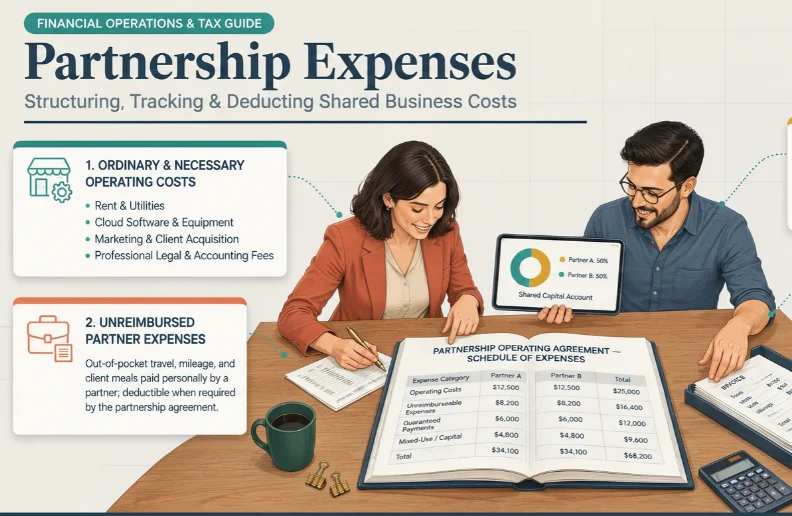
Partnership expenses can affect both the partnership’s tax return and each partner’s individual return. Most ordinary business costs belong on Form 1065 at the partnership level. Certain required costs paid personally by a partner may qualify as unreimbursed partnership expenses instead.
Understanding that distinction matters because partners cannot freely choose where to claim a cost. The expense must meet federal deductibility rules and follow the partnership agreement. Good records also help prevent duplicate deductions or missed expenses.
| Key question | Practical U.S. answer |
|---|---|
| Who normally deducts partnership business costs? | The partnership reports ordinary business deductions on Form 1065. |
| Can a partner deduct costs paid personally? | Sometimes, when the partnership agreement requires the partner to pay them without reimbursement. |
| Where are qualifying unreimbursed costs reported? | Generally on Schedule E, subject to applicable passive-activity rules. |
| Are all business costs immediately deductible? | No. Some costs must be capitalized, amortized, or separately reported. |
| Are partner distributions business expenses? | No. Distributions generally are not operating deductions. |
| Are guaranteed payments deductible? | Certain guaranteed payments for services or capital may be deductible by the partnership. |
| What records should partners keep? | Receipts, invoices, mileage records, payment evidence, and the partnership agreement. |
Direct answer: A U.S. partnership generally deducts ordinary and necessary business costs on Form 1065. A partner may separately deduct qualifying unreimbursed costs only when required to pay them under the partnership agreement. Those expenses must meet federal business-expense rules and may be reported through Schedule E.
What Are Partnership Expenses?

Business Partnership Expenses: Partnerships spend money to operate, earn revenue, maintain property, and serve customers. Common costs include rent, utilities, insurance, supplies, professional services, and certain travel expenses. Their tax treatment depends on the nature and purpose of each payment.
The IRS generally treats a partnership as a pass-through entity for federal income tax purposes. The partnership reports income, deductions, gains, losses, and other items on Form 1065. Profits and losses then flow to partners through their reporting information.
This structure makes accurate expense classification important. A cost deducted by the business reduces partnership income before allocations occur. Separately stated items may instead require each partner to apply individual tax rules.
Common Deductible Costs for a Partnership
Many routine operating costs may qualify when they are ordinary and necessary for the business. The exact treatment depends on federal rules and the facts surrounding each expense. Businesses should avoid assuming that every cash payment creates an immediate deduction.
Common categories of deductible costs include the following.
- Office rent and certain facility costs
- Business utilities
- Insurance premiums
- Legal and accounting fees
- Supplies consumed by the business
- Eligible travel costs
- Certain non-entertainment business meals
- Depreciation or other allowable asset deductions
- Certain guaranteed payments to partners
- Qualified startup or organizational costs
The IRS Form 1065 instructions specifically identify several ordinary deduction categories. They also explain special rules for meals, capitalization, organizational expenses, and guaranteed payments. Some items must be reported separately rather than included with ordinary operating deductions.
Accurate books make these classifications easier at tax time. Business owners should keep revenue and expenses distinct throughout the year. BusInvesty’s explanation of revenue versus sales can help clarify another common bookkeeping distinction.
Partnership Expenses Paid by the Business vs. the Partner
The cleanest arrangement is usually for the partnership to pay its own operating bills. The payment enters the partnership records and receives appropriate tax treatment there. Partners then receive their distributive tax information after the year closes.
Problems often arise when one partner personally pays a partnership obligation. A personal payment does not automatically create an individual deduction. The reimbursement policy and partnership agreement become important.
Partners should document who is expected to pay each expense category. They should also define which expenses the partnership reimburses. Clear written rules can reduce disputes and improve consistent tax reporting.
When Can a Partner Deduct Unreimbursed Partnership Expenses?
The IRS allows certain unreimbursed costs when specific conditions are satisfied. The partner must generally have paid an ordinary and necessary partnership business expense. The partnership agreement must also require that partner to bear the cost without reimbursement.
That requirement separates deductible UPE from voluntary personal spending. A partner usually cannot create a deduction by choosing not to request an available reimbursement. The agreement and actual reimbursement policy should support the treatment.
Examples might include required business mileage, home-office costs, professional expenses, or supplies in appropriate circumstances. Each cost still needs to satisfy the normal federal rules for that expense. Personal expenses remain nondeductible even when they indirectly relate to business ownership.
How Are Unreimbursed Expenses Reported?
Current IRS Schedule E instructions direct qualifying partners to report unreimbursed business costs in Part II. Nonpassive costs are generally shown separately rather than netted against the partnership’s reported figures. The entry is identified as UPE on Schedule E.
Passive activities can require different treatment. Form 8582 may apply when passive-activity limitations affect the deduction. Basis, at-risk, and excess-business-loss rules can also limit partnership losses.
Partners should therefore avoid treating Schedule E as a simple reimbursement worksheet. Several tax limitations may apply before a deduction reaches the individual return. A tax professional can evaluate the interaction when the numbers are material.
Which Costs May Need Special Treatment?
Not every legitimate business cost receives an immediate deduction. Some expenditures create assets or benefits extending beyond the current tax year. Those costs may require capitalization, depreciation, or amortization.
Startup and organizational expenses are a common example. The Form 1065 instructions permit certain treatment for qualifying costs, while remaining amounts can require amortization. Syndication expenses follow stricter rules and generally cannot be deducted like routine operating expenses.
Business interest can also face special limits. Section 163(j) contains rules limiting some business interest deductions. Partnerships have entity-specific procedures for applying those restrictions.
How Guaranteed Payments Affect Partnership Costs
A guaranteed payment is generally determined without reference to partnership income. It can compensate a partner for services or the use of capital. Certain qualifying guaranteed payments are deductible when connected with a trade or business activity.
These payments differ from ordinary partner distributions. A distribution generally represents money or property transferred to a partner because of ownership. It does not become a deductible operating expense merely because the partnership sends cash.
The distinction affects both the entity and the recipient. Guaranteed payments appear in partnership reporting and also affect the partner’s individual tax information. Professional advice can help when compensation arrangements become complex.
Meals, Travel, and Entertainment Costs
Business travel can be deductible when it has a legitimate business purpose. The partnership must maintain records supporting the purpose, dates, location, and amounts. Personal travel remains outside the deduction.
Business meal deductions also have specific limits. The Form 1065 instructions state that qualifying non-entertainment meals are generally subject to a 50% limitation. Entertainment expenses are generally nondeductible under current federal rules.
Partners should separate these categories in their accounting system. Combining travel, meals, and entertainment under one expense account creates extra work later. Detailed categories also make year-end reviews easier.
Why Separate Business Banking Helps
A dedicated business account does not determine whether an expense is deductible. It can still make recordkeeping much easier. Separate accounts create a clearer trail between partnership income and partnership costs.
That separation matters when several partners can make purchases. It also reduces confusion between distributions, reimbursements, owner contributions, and operating costs. BusInvesty’s guide to online banking and account management provides useful background on managing business banking digitally.
Partnerships should also reconcile accounts regularly. Monthly reviews can identify missing receipts and unusual transactions before tax season. Waiting until year-end increases the chance of classification mistakes.
A Practical Expense-Tracking System for Partners
The best system is one every partner follows consistently. Written rules should explain which expenses need advance approval. They should also explain how reimbursement requests work.
A simple process may include:
1. Pay partnership expenses from partnership accounts whenever practical.
2. Photograph or save each receipt immediately.
3. Record the business purpose with the transaction.
4. Assign the correct accounting category.
5. Submit reimbursable partner costs promptly.
6. Flag required unreimbursed expenses separately.
7. Reconcile bank and credit-card accounts monthly.
8. Review unusual transactions before year-end.
This process helps establish a reliable financial record. It can also support future lending, due diligence, or a business sale. BusInvesty’s guide to selling a U.S. business explains why organized financial documents matter during buyer reviews.
Example: A Partner Pays a Required Business Cost
Assume two partners operate a consulting firm. Their written agreement requires each partner to pay certain local travel costs personally. The business does not reimburse those costs.
One partner spends $1,200 on qualifying business transportation during the year. Proper records show the dates, destinations, business purposes, and payments. The expense may qualify for partner-level treatment if all federal requirements are satisfied.
Now change one fact. The partnership offers full reimbursement, but the partner never submits the expense report. That situation may not support the same individual deduction because payment was not necessarily required without reimbursement.
Common Mistakes to Avoid
The first mistake is paying partnership costs personally without a written policy. Tax treatment becomes harder to support when reimbursement expectations are unclear. The partnership agreement should address recurring expense responsibilities.
Another problem is deducting the same cost twice. A partnership should not deduct an expense and then allow the partner to claim that identical expense again. Reconciliations should identify reimbursements and personal payments before returns are prepared.
Partners also sometimes confuse distributions with business expenses. Cash transferred to owners does not become deductible merely because it leaves the business account. Accurate coding prevents that misunderstanding.
Keep Expense Rules Clear Before Tax Season
A partnership should decide its expense and reimbursement procedures before partners start spending personal funds. Clear policies make the books easier to reconcile. They also create stronger support for tax reporting.
Partners should review the agreement when recurring expenses remain unreimbursed. Federal tax treatment can change based on the type of expense and activity. State tax rules may also differ from federal treatment.
For complex expenses, passive activities, substantial losses, or unusual partner compensation, consult a qualified U.S. tax professional. Good advice can prevent incorrect deductions and duplicate reporting. Strong records also make every later financial decision easier.
Frequently Asked Questions
Are partnership expenses tax deductible?
Many partnership expenses are deductible when they are ordinary, necessary, and connected with the business. Some costs face limitations or require capitalization instead. The correct treatment depends on the expense and applicable federal rules.
Can a partner deduct expenses paid from a personal account?
Possibly, but personal payment alone is not enough. IRS guidance generally requires the expense to be ordinary, necessary, and required under the partnership agreement without reimbursement. Proper records should support both the expense and the obligation.
Where do unreimbursed partner expenses go on a tax return?
Qualifying unreimbursed expenses are generally addressed in Schedule E reporting. Passive-activity rules can change how the deduction is handled. Form 8582 and other limitations may apply in some cases.
Can a partnership deduct guaranteed payments to partners?
Certain guaranteed payments for services or capital can be deductible by the partnership. The payment generally must relate to the trade or business and meet federal requirements. Capitalized activities can receive different treatment.
Are partner distributions deductible business expenses?
No, ordinary distributions are generally not operating deductions. They represent transfers connected with the partner’s ownership interest. Guaranteed payments follow different tax rules.
